Maldives Jet Ski Guide: Resort vs Local Island
Explore the ultimate Maldives jet ski guide comparing resorts and local islands. Discover the best options for jet skiing in Maldives and make the most of your travel experience.
JETSKI & MOTOR SPORTS
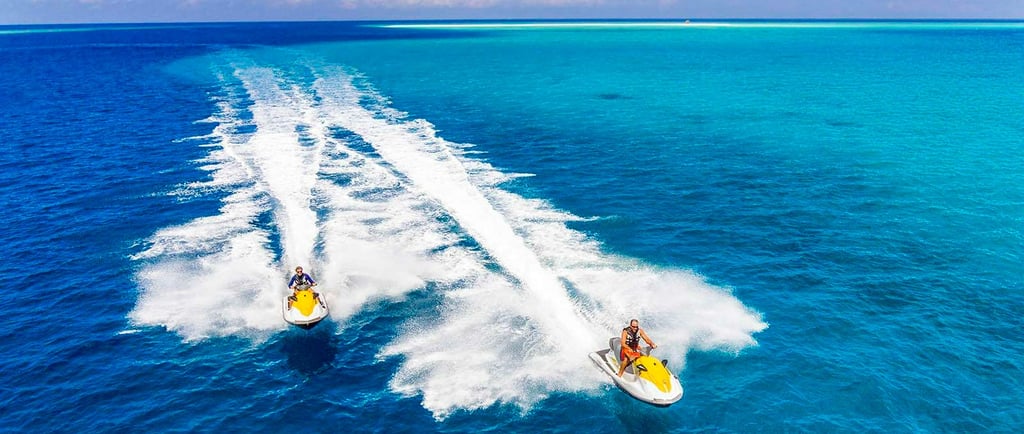
If you want to ride a jet ski in the Maldives, the two most common choices are booking through a private resort watersports center or arranging it from a local island such as Maafushi. Both can be fun, but they are sold very differently. Resorts usually offer more controlled, guided, premium experiences, while local islands tend to be more budget-friendly and sometimes bundle jet ski time into combo tours or island-hopping trips.
Cost: local island usually wins
Resort pricing is typically much higher. For example, Anantara Veli lists jet ski at USD 160 for 15 minutes, USD 270 for 30 minutes, and USD 395 for 60 minutes per jet ski, while The St. Regis Maldives Vommuli shows guided jet ski pricing starting around the low USD 200s per jet ski before service charge and tax. By contrast, local-island offers around Maafushi commonly package 15 minutes of jet ski with other activities, and one Gulhi jet-ski tour was reviewed at about USD 115 per person for a much longer outing.
Rules and restrictions: resorts are usually stricter
Resorts tend to publish clearer operating rules. Anantara Veli states a minimum driving age of 16, and St. Regis Maldives also lists a minimum rider age of 16, noting parental or guardian accompaniment. Resort jet ski is also often explicitly sold as a guided trip, which means you are following a guide rather than riding freely wherever you want. Local-island tours can still have restrictions, but public-facing listings are often lighter on written policy details and more focused on the tour itself.
Ride areas: resorts keep you in designated lagoons or guided routes
At resorts, the riding area is usually controlled and tied to the property’s lagoon or a guide-led route. Anantara Veli labels jet ski as a private guided trip, and St. Regis says the price includes one jet ski for the guest and one jet ski for the guide, which strongly suggests a supervised route. Local-island products can be broader in feel: one Maafushi combo describes riding on the shallow seawater around Maafushi, while a Maafushi–Gulhi jet-ski tour turns the ride into inter-island sightseeing.
Time limits: resorts are straightforward, local islands can be more mixed
Resorts usually sell jet ski in clean time blocks like 15, 30, or 60 minutes. Anantara Veli is a clear example of that structure. Local islands often still use short 15-minute jet ski slots for simple rentals or combo packages, but they may also sell longer jet ski-based excursions that include stops, snorkeling, or island visits, so the total experience can feel longer even when actual riding time is limited.
Equipment quality: resorts tend to feel more premium
Resorts usually have more polished watersports centers and more consistently premium equipment. That does not automatically mean local-island equipment is poor, but resort operations generally market themselves around high-end guest experience and structured supervision. Local islands can still be perfectly good, especially on busy tourism islands like Maafushi, but quality may vary more by operator than it does at branded resorts. This is partly an inference from how the experiences are sold: resorts publish detailed watersports brochures and guided formats, while local-island listings are more activity-led and operator-specific.
Safety supervision: resorts usually provide tighter control
This is one of the biggest differences. Resort jet ski is often tightly supervised. St. Regis Maldives explicitly says the guided price includes a separate jet ski for the guide, and Anantara Veli calls it a private guided trip. Local islands also use guides and instructors, especially for tours, but the supervision style can feel more relaxed and depends more on the operator you book with. For example, one Hulhumalé operator description emphasizes that guides help with powersports and watersports activities.
How booking works
At resorts, booking is usually done through the in-house watersports center or concierge, often charged to your room and subject to weather and schedule slots. Resort brochures also commonly note that activities are available on request. Local-island booking is more likely to happen through a guesthouse, tour desk, walk-in operator, or an online activity listing like the Maafushi combo. That usually makes local-island booking more flexible on price shopping, but less standardized than resort booking.
Quick decision guide
Choose resort jet ski if… you want the easiest booking, newer-feeling equipment, clearer safety rules, closer supervision, and a polished experience where everything is handled for you.
Choose local island jet ski if… you care more about value, want to compare operators, like the idea of combo tours or island-to-island rides, and do not mind a more variable, less luxury-styled setup.
Final verdict
For most travelers, resort jet ski is better for comfort, structure, and supervision, while local island jet ski is better for price and flexibility. If this is your first time and you want a smooth, worry-free experience, resort booking is usually the safer bet. If you are trying to keep costs down or want a more independent Maldives trip, local islands like Maafushi are often the better match.